 |
| 1 . |
|
Which of these statements is true of sponges? (Activity 18A) [Hint]
|
|
| 2 . |
|
Which of these statements is true of cnidarians? (Activity 18A) [Hint]
|
|
| 3 . |
|
Earthworms are in the phylum _____. (Activity 18A) [Hint]
|
|
| 4 . |
|
Which of these statements is true of earthworms? (Activity 18A) [Hint]
|
|
| 5 . |
|
Snails are classified in the phylum _____. (Activity 18A) [Hint]
|
|
| 6 . |
|
Grasshoppers are classified in the phylum _____. (Activity 18A) [Hint]
|
|
| 7 . |
|
Which of these is a characteristic of sea stars? (Activity 18A) [Hint]
|
|
| 8 . |
|
Dogs are classified in the phylum _____. (Activity 18A) [Hint]
|
|
| 9 . |
|
This phylogenetic tree indicates that birds are most closely related to _____. (Activity 18B) 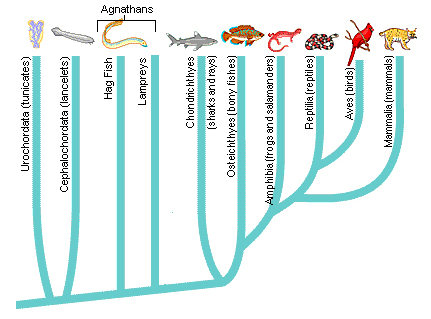 [Hint] [Hint]
|
|
| 10 . |
|
This phylogenetic tree indicates that the most recent common ancestors of reptiles, birds, and mammals are _____. (Activity 18B) 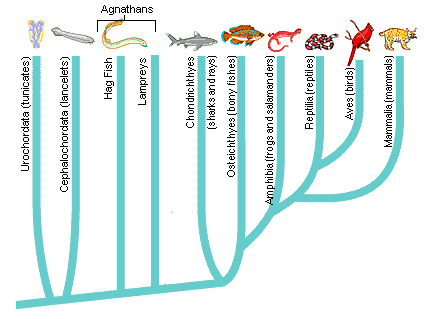 [Hint] [Hint]
|
|
| 11 . |
|
Which of these chordate groups lack a post-anal tail and a notochord as adults? (Activity 18B) [Hint]
|
|
| 12 . |
|
The common ancestor of all these chordate groups EXCEPT the _____ probably had paired appendages. (Activity 18B) [Hint]
|
|
| 13 . |
|
According to this phylogenetic tree, annelids are most closely related to _____. (Activity 18C) 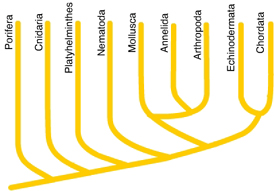 [Hint] [Hint]
|
|
| 14 . |
|
According to this phylogenetic tree, the group that includes echinoderms and chordates is most closely related to the group that includes _____. (Activity 18C) 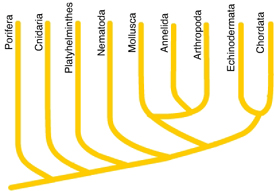 [Hint] [Hint]
|
|
| 15 . |
|
According to this phylogenetic tree, cnidarians are most closely related to _____. (Activity 18C) 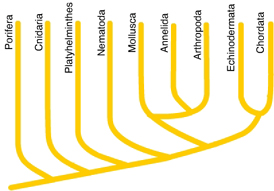 [Hint] [Hint]
|
|
| 16 . |
|
According to this phylogenetic tree, chordates are most closely related to _____. (Activity 18C) 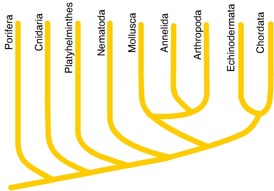 [Hint] [Hint]
|
|
| 17 . |
|
At the phylum level, you are most closely related to a(n) _____. (Activity 18C) [Hint]
|
|
|
